
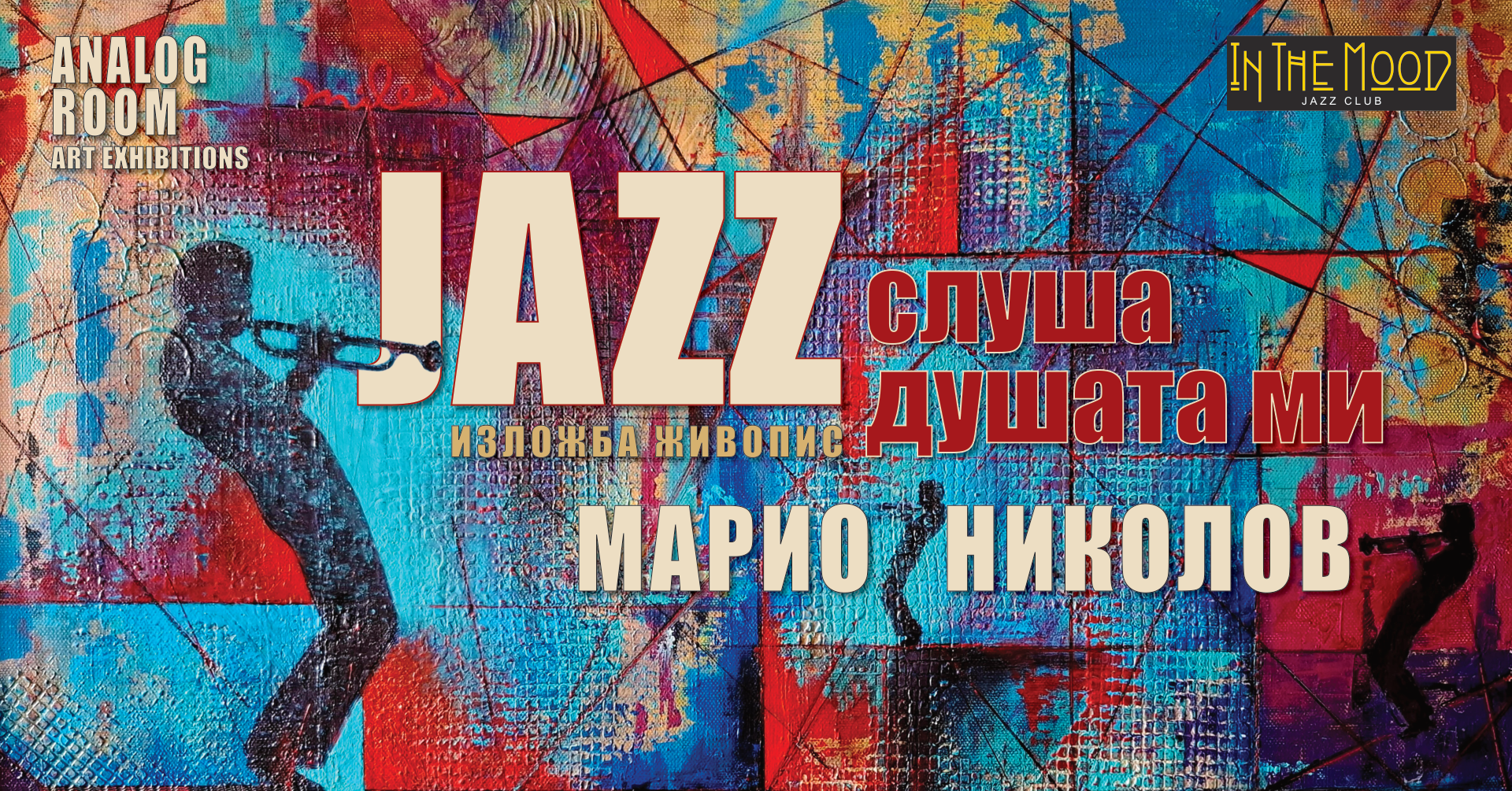
Sixty years ago, in 1966, the American jazz pianist and composer Bill Evans (1929–1980) said backstage at New York’s Town Hall: “It bothers me when people try to analyse jazz as an intellectual theorem. It isn’t that. It’s a feeling.”
Although I am far removed from his extraordinary musical talent, and from music in general, both in theory and in practice, that is precisely how I perceive jazz: as a feeling. And as… colours.
A feeling of the human spirit soaring endlessly above the petty and the mundane; a rising above the transient and the everyday; a sense of Freedom and Eternity that only true Art can evoke.
In 2002, I published my second—and last—collection of poetry, My Dreams Listen to Jazz. As its 25th anniversary approaches, fate has given me an unexpected yet wonderful gift: in early July this year, thanks to some dear friends, I visited In The Mood Jazz Club at 52 Pozitano Street in Sofia for the first time. I was captivated by this extraordinary place, its music and its atmosphere—and after a brief conversation with Vasil Karkelanov, we shook hands on an exhibition in the autumn!
If I am to take on the role of the student in the timeless Zen saying, “When the student is ready, the teacher appears,” I must admit that my first meaningful encounter with jazz took place in 1993, in the studio of what was then Radio Tangra. Perhaps I was already ready, because what followed felt like an unreal “jam session”—a term whose meaning I only learned later—in which immense respect for the exceptional skill and professionalism of jazz musicians intertwined with amazement at their talent, metaphysical mystery, crystal-clear exhilaration and an indescribably inspiring mood. I do not know whether jazz and I became true friends, but for me it became an enthralling journey through an unimaginable, surreal world of feelings, emotions and colours. And yes, ever since then, My Soul Listens to Jazz…
Having mentioned fate, I cannot leave out another fateful experience. Also in July this year, I had the good fortune to attend We Want Miles!, a concert by the celebrated bass guitarist Marcus Miller, dedicated to the centenary of the birth of trumpeter Miles Davis (1926–1991) and to his boundless genius.
The project revisited Miles’s legendary 1982 live album of the same name, recorded the previous year in Boston, New York and Tokyo. Alongside Miller, three other musicians from the original recording line-up were on stage: Mike Sternon guitar, French percussionist Mino Cinelu, and soprano saxophonist Bill Evans—no relation to pianist Bill Evans, who, incidentally, played with Miles on the masterpiece Kind of Blue (1959).
I have devoted more space to this concert because it became a catalyst of sorts for several of the paintings presented in this exhibition.
To arrive at canvases such as Miles I, Miles II and Siesta, and the works in the Flamenco series—painted earlier in memory of the virtuoso guitarist Paco de Lucía (1947–2014)—I had to read extensively and listen to a great deal of music. But I also had to respond to a truly demanding challenge: how could I convey my feelings, my perception and my understanding of the universe called JAZZ? Through my senses and in colour, rather than through music theory. Because, to me, jazz is, at its very core, personal music too—which is why this text is written in the first person. To find the right direction, I once again had to paraphrase the great Man Ray (1890–1976): “Since I cannot play any of it [my own note: I mean myself], I can try to paint it or describe it. But my heart is in painting…”
To take even a few steps into the vast expanses of this music, in the exhibition My Soul Listens to Jazz I moved through various artistic styles, from pure abstraction and expressionism to surrealism, and through multilayered visions—as multilayered as jazz itself. As far as possible, I shared in the dramatic stories and destinies of Charlie Parker, Miles Davis, Bill Evans, Chet Baker, Ray Charles, John Coltrane and others. There could be no more fitting description of these lives than the title of Irving Stone’s (1903–1989) book The Agony and the Ecstasy (1961), his biographical novel about Michelangelo Buonarroti (1475–1564).
While painting, I also came across words that Miles Davis said to drummer Jimmy Cobb (1929–2020) before recording So What in 1959: “Make it sound like it’s floating.” And I tried to carry them over into… painting.
Especially for the space—and the idea—of Analog Room at In The Mood, and as a devoted admirer of the Tenth Muse, I also painted four works: a kind of remake of four of the most important jazz-related feature films in cinema history, in my view. They are ’Round Midnight (1986) by French director Bertrand Tavernier (1941–2021), starring the celebrated saxophonist Dexter Gordon (1923–1990), with music by Herbie Hancock (b. 1940); Bob Fosse’s (1927–1987) classic All That Jazz (1979)*; Born to Be Blue (2015) by Canadian director Robert Budreau (b. 1974), dedicated to the exceptional trumpeter Chet Baker (1929–1988) and featuring a magnificent performance by Ethan Hawke (b. 1970); and Bird (1988) by the great Clint Eastwood (b. 1930), which tells the story of legendary saxophonist Charlie Parker (1920–1955).
In this exhibition, which I would describe as intimate in scale yet sacred to me in a particular way, I have tried to look beyond the material dimensions of jazz and to illustrate its boundless spaces: the different tonalities, perspectives and reveries through which we pass while listening to this blessed music. Despite the current tectonic shifts in culture, aesthetics, morality and spirituality, which are becoming ever more intrusive, more senseless and more aggressive, relentlessly engulfing our lives. And perhaps that is why, more and more often… My Soul Listens to Jazz.
* Note: The opening of the exhibition Jazz Listens to My Soul, on 10 November 2026, marks the 94th anniversary of the birth of Roy Scheider (1932–2008), the actor who played the leading role in All That Jazz.
Artist Biography
MARIO NIKOLOV was born on 14 February 1964 in Sofia, Bulgaria.
In 1982, he graduated from the school of artistic stone carving in Kunino, Vratsa Province – the only school of its kind in the Balkan Peninsula and one of four state schools with a similar specialisation in Europe.
Between 1992 and 1993, he studied graphic design and advertising at the college affiliated with the Faculty of Journalism at Sofia University “St. Kliment Ohridski”. He works in painting, applied arts, graphic design and literature.
He has participated in more than 25 solo and group exhibitions in Bulgaria and abroad.
His works are held in private collections in Austria, Bulgaria, Germany, Greece, the United States, Slovakia, Türkiye, France, Croatia, the United Kingdom and the Czech Republic.
His debut poetry collection, MuziMuzeiMuhi, was published by Hermes in July 1997. His second book, My Dreams Listen to Jazz, was published by FAMA in July 2002. In November 2007, it was adapted into a multimedia performance that opened the 30th National Jazz Meeting in Ruse.
From 1992 to 2000, he worked successively for the newspapers Rudnichar, Podkrepa, PARI and others, and from early 2001 until November 2008 for Dnevnik.
From 1 June 2011 until the end of April 2018, he published the arts and culture website artnovini.com, which he founded and served as editor-in-chief.
Mario Nikolov has written and edited more than 3,000 news articles, analyses, commentaries and interviews on art and culture.
He has been a member of the Union of Bulgarian Artists since 2016 and the Union of Bulgarian Journalists since 2007.
In spring 2013, he and his wife, Stefka Nikolova, moved to Friedrichshof in Burgenland, Austria, before settling in Vienna that autumn. He has worked at some of the Austrian capital’s largest museums and is currently a member of the team at the Belvedere Museum.